


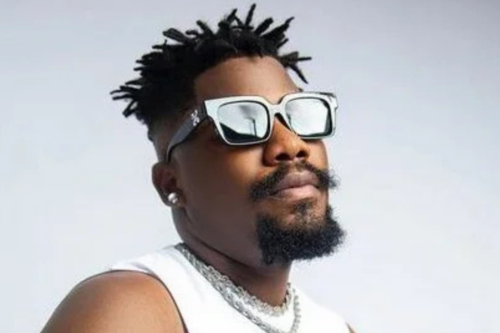
The first time I listened to Kimilist was when he dropped Bad Boy Diaries in 2024. Intriguing is the best way to describe his music. As a rap artist from Kumasi, Ghana, Kimilist isn’t bound by the usual conventions of hip-hop. Instead, he creates music based on how he feels, blending rap, singing, and Ghanaian influences into something uniquely his.
Barely a year later, he returned with Bad Boy, a track that feels like a continuation of his earlier project — rich with twi, pidgin, and English, and layered with themes of identity, ambition, and self-expression.
When I finally connected with him for this interview, it was clear I wasn’t just speaking to a rapper but to an artist determined to carve his own lane. Kimilist comes across as chatty, hopeful, and deeply intentional about his craft. He is building a sound rooted in Ghana yet wide enough to resonate beyond borders.
For this conversation, it’s as though he paints a picture of himself in bright colors: a talented rapper, a musician beyond labels, and an artist intent on bringing his culture into everything he creates.
Enjoy!
Q: I read one of your very recent interviews, I think the one with Solid Mag, and something caught my attention. You mentioned that you want to be as genuine as possible with regards to your music. On that, how then would you describe your artistry? Who exactly is Kimilist?
Q: So that’s how exactly you would describe your artistry?
A: Yeah.
Q: You mentioned that you weren’t following a blueprint and you tend to stay original. How would you define originality? What’s originality to you?
A: Being original is just being who you are as a person. Since I’m a Ghanaian and also African, even though I started listening to foreign music a lot before I got to listen to local music. Coming up, I always wanted to rap like these hip-hop artists—Tyga, Lil Wayne, Kanye West—but forgetting we also have music legends out here who stayed original to their roots, in sync with what goes on here and the sound from where we are from. Staying original is adapting to the sounds we already have here and spreading it outside for the world to hear, just as the hip-hop heads outside Ghana made sure we heard their music.
Q: Speaking of Kanye West, the internet pointed to the fact that Kanye West is one of your biggest influences. But don’t you think that there’s a contradiction? You mentioned that you’re not following a blueprint, but there’s Kanye West as one of your biggest influences.
A: No, I would say how he actually works. Kanye is always open to try new stuff and also learn things and bring out something new. Anytime Kanye comes out, it’s something new. That’s the side of Kanye I’m more interested in. So if I talk about being influenced by Kanye, I mean that’s the direction I’m actually following.
Q: So if I get you right, that means you balance dealing with Kanye as an influence and carving your own lane in terms of what you define as originality?
A: Yeah, that’s right.
Q: Earlier on when I asked who is Kimilist, you explained that you are a Ghanaian rap artist. But your sound goes beyond rapping. You’re also a singer. Are you saying or would you define yourself as strictly a rapper, or are you one of those artists who would rather not conform to any label?
A: Yeah, I wouldn’t conform to any. Because for me, I’m a musician. Music comes with the mood. Even though I started rapping, I also love to sing. In my own way, I think it actually sounds good when I use my own voice to sing. Basically, I’m a musician. When the mood is right for me to sing, I sing. When it’s right for me to rap, I rap. When it’s time to blend both on one song, I’ll do that as well. I even have an EP titled Bad Boy Diaries. If you listen to that EP, that’s like the whole Kimilist package.
Q: Speaking of Bad Boy Diaries and your very recent release. You dropped Bad Boy Diaries last year and last month you dropped Bad Boy. What’s the connection between the two of them?
A: Bad Boy, the new song, is a continuation of Bad Boy Diaries, but it couldn’t make the list. So I had to do it as the second version of the actual Bad Boy Diaries EP. The first one was feel-good music, less of the Ghanaian original sound. Since I’m focusing more on the Ghanaian sound now, I had to separate both of them. It’s still the continuation of Bad Boy Diaries. I’m still an active Bad Boy.

Q: So are we to expect some sort of part one and part two with these projects?
A: Yeah, you should. I’ve been working on different songs. So when it’s time for the next one to come, you guys will understand.
Q: I’m interested about the twi part of your new single. Can you break down the narrative or story behind Bad Boy?
A: The funny thing is, in the studio me and my producer were talking about “soapy.” And always we are about chasing money, because I want people to understand where we are from and the type of situation we are in. So that’s how the verse starts: Gwap chase when the eyes open/ W’anya bi a nawo pae soapy. If you don’t get money, or you don’t get some of the honeys, it could be you alone eventually. It was about letting people understand how life goes on here, what the youth go through, and fun moments too. My producer understood the assignment—we wanted something local. I was listening to old Ghanaian music like Adadamu, Highlife, and Jama. Everybody in Ghanaian high school has done Jama before, just chanting lyrics. We decided to make it happen in a modern way.
Q: What about Bad Boy Diaries? Since there’s a link between Bad Boy Diaries and Bad Boy, I want to know the narrative behind the EP.
A: With Bad Boy Diaries I wanted it to be more of a bad boy love story. The new Bad Boy was going out of the love story, so it didn’t make the list. But it still has the attitude and energy of a bad boy. The identity of a bad boy is still there. Bad Boy Diaries is more about the love story.
Q: I feel like a thing I’ve noticed in your music revolves around women. Do you feel like it comes from growing up around women, or do you find it easier to explore this theme rather than the stereotype of rappers always being deep?
A: Exactly. I’ve mostly been around women. I think women are amazing people. They like to talk about interesting stuff, and they are very interesting to be around. As James Brown says, the world was built by a man, but it would be nothing without a woman or a girl. You can’t take them out of anything. So for me, Kimilist and women are like five and six—in a positive way.
Q: Many of your collaborations have been with Ghanaian creatives. Do you see yourself working with Nigerian artists in the near future?
A: Oh yeah. I like Nigerian music, I like how far they’ve taken their culture. It would be very nice to work with a Nigerian artist. As a musician, if the music is good, I don’t care. We have to do something no matter the language barrier. Nigerians are our brothers already.
Q: Could you name drop, even if it’s just two, of Nigerian artists you would love to work with?
A: One would be Asake—I like how he connects his local roots, his language, everything, with his vibes. That’s amazing. Two would be Blaqbonez. As a rapper, I like Blaqbonez. Also Odumodu. I met Odumodu last year at a Stonebwoy video shoot. We had a conversation. He was very nice, listened to our music. Rema, Ayra Starr, as well, and Bloody Civilian.
Q: As a Ghanaian artist coming out of Kumasi, looking beyond Ghana, what is it like trying to push your sound to a wider audience?
A: It’s very hard. In Ghana, the industry is tough. If you don’t know somebody, it’s very hard because there’s no system that easily leads you in. Most people are gatekeeping unless you know them. Sometimes it’s just by grace that somebody will link up. We have award schemes like Ghana Music Awards in the UK, which I’ve been nominated for three times, and that helps. But aside from that, it’s not easy.
Q: I think that’s a problem in Nigeria as well. Even though our music has gotten a bigger global reach, there’s still the issue of access and connections. It’s not easy here either.
A: Exactly. It’s a common problem. There should be systems in place to help artists coming up, especially when the talent is there.
Q: What would you say is the biggest challenge for artists in the Ghana music industry?
A: Connection. As simple as how information reaches people. It should be easy to get in touch with people aligned with our work, but here you’ll never see that unless you know somebody that knows somebody. For example, Nigerian artists come to Ghana, and by the time you hear about it, they’re leaving. Those who had the information already connected with them. There should be a system to make this easier.
Q: Looking back, what has been the most defining moment of your career?
A: When I dropped “Sika” featuring Yaw Tog. At that moment, his music was everywhere, especially in the UK. Drill music was at its peak. Having a song with him then made my name go far. People went crazy over the song, even people I didn’t know reached out. That was a defining moment.
Q: What milestone are you aiming for next?
A: To be one of Africa’s biggest music exports. That’s one thing I’m really aiming for.
Q: From this conversation, one thing I find fascinating about you is your determination — you’re not trying to follow the typical narrative of African rappers or artists. I love the fact that you’re bringing culture into your sound and your craft. That’s why it makes so much sense that you hope to collaborate with Asake someday. Asake always sings in Yoruba, and even with that, he’s on a very big level. So I believe that as long as your sound is good — and it is — people will get right on it.
A: I appreciate it. It was really nice having this conversation.
Q: Same here! Enjoy the rest of your week. And thank you for your time.







Leave a Reply